This fictional story is an original rewrite inspired by the linked premise.
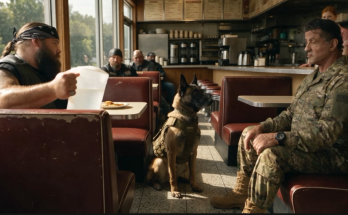
The lunch bell had barely stopped ringing when the mess hall at Fort Arden turned cruel.
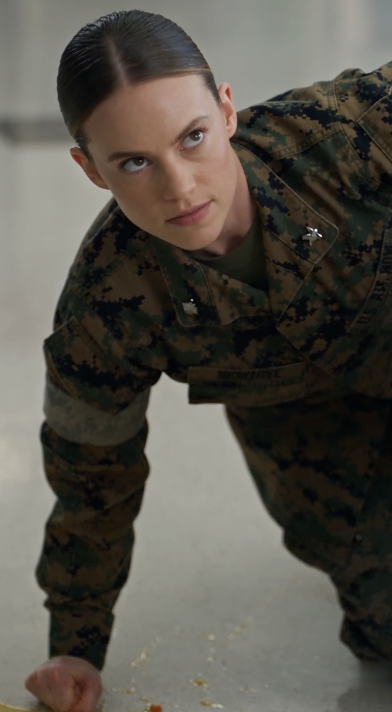
Specialist Mara Vale was carrying a tray past the windows when Sergeant Keane hooked a boot around the leg of her chair. The chair went over, the tray skidded, and a cup of cold water struck the floor beside her hand.
Laughter moved through the room before anyone moved to help. At the far table, Sylvester Stallone looked up from his coffee. He had come to the base as a retired instructor, but the stillness in his face belonged to someone who had learned to recognize danger before it announced itself.
Chapter 1 — THE SPILLED TRAY
Keane stood over Mara with his hands open, as if the accident had happened by itself.
“You should watch where you sit,” he said. “Some tables belong to people who know how to behave.”
Two soldiers near the serving line laughed because Keane was watching them. A third raised his phone and framed the scene. Mara pushed herself upright, wiped water from her sleeve, and looked at the tray scattered across the tiles.
She did not cry. She did not shout. That disappointed Keane more than anger would have.
Stallone rose from his chair, but he did not walk toward Keane. He walked toward Mara.
“Are you hurt?” he asked.
“My wrist is sore.”
“Then we start there.”
He helped her stand without touching the injured wrist. The room had become quiet enough to hear the refrigeration unit behind the serving counter.
Keane folded his arms. “This is a private unit matter.”
Stallone turned to him. “A chair was kicked. A service member was knocked to the floor. There are witnesses. That makes it a matter for the record.”
Keane smiled as if the word record were a joke. “You don’t even belong to this command.”
“No,” Stallone said. “That is why I can see what you have all decided to ignore.”
Mara looked at him then. For the first time that afternoon, she seemed less alone.
Chapter 2 — THE THIRD FORM
At the clinic, the medic wrapped Mara’s wrist and asked whether she wanted to report the incident.
“I have reported him twice,” Mara said.
She removed a folded sheet from the inside pocket of her jacket. The first report concerned a training-room threat. The second described a locked equipment cage and a warning that she would regret “making noise.” Both forms had been signed. Neither had received a case number.
Stallone read the pages without taking them from her hand.
“Why keep copies?” he asked.
“Because the originals keep disappearing.”
Her third form was still blank. She placed it on the desk and stared at the line marked incident description.
“Write only what you saw,” Stallone said. “No conclusions. No apology. Facts survive people who want them gone.”
Mara began writing. The pen shook once, then steadied.
Outside the clinic, Private Lucas Reed waited beside the vending machines. He had been one of the soldiers who laughed. He had also been the one holding the phone.
“I recorded everything,” he said.
Mara looked at him. “Why?”
“Because I knew somebody would say it didn’t happen.”
Stallone studied the young private’s face. Reed looked frightened, but he had come back.
“Then don’t hide the truth inside your pocket,” Stallone said. “Bring it to the person who can protect it.”
Chapter 3 — THE QUIET RECORDER
Reed led them to an empty classroom and opened a folder on his phone. There were seven short videos, three audio recordings, and screenshots of messages that Keane had sent after the first complaint.
In one message, Keane wrote that Mara would “learn what happens to people who confuse paperwork with power.” In another, a supervisor asked Reed whether he had “seen anything worth reporting.”
Reed had answered no.
“I was scared,” he said. “I told myself I was collecting evidence. Then I realized I was using evidence as an excuse to keep standing beside him.”
Mara watched the screen. Her face stayed calm, but her thumb pressed hard against the edge of her bandage.
“You laughed today,” she said.
“I know.”
“That is part of the record too.”
Reed nodded. “I will tell them.”
Stallone closed the classroom door. “The truth is not a costume you put on after the danger passes. If you are going to speak, you speak about your own part first.”
Reed transferred the files to an encrypted drive and gave a copy to Mara. A second copy went to a civilian inspector whose number was printed on the base notice board.
When the transfer finished, a new message appeared on Reed’s phone. It came from Master Sergeant Holt, the senior enlisted adviser who had reviewed Mara’s first complaint.
Stop digging.
Stallone read the message once. Then he asked Reed to photograph it.
Chapter 4 — THE BURIED FILE
Colonel Avery Hargrove received them after sunset. He listened while Mara described the mess hall, then examined the two missing reports and the new case form.
“The first complaint was routed through Sergeant Holt’s office,” he said.
“And the second?” Stallone asked.
“The same route.”
Hargrove opened the command database. The first report had no entry. The second had been marked incomplete even though the signature page was present.
“That is not an administrative mistake,” Mara said.
“No,” the colonel replied. “It is a pattern.”
He asked an aide to retrieve the paper archive. Twenty minutes later, the aide returned with an empty folder and a report that the records room had been reorganized three months earlier.
Stallone walked to the window. Below, the lights of the motor pool formed a neat line across the darkness.
“The missing pages are not the only evidence,” he said. “People remember who told them to stop speaking.”
Hargrove looked at Reed. “How many witnesses?”
“I know of six.”
“Then invite all six to speak separately.”
Holt entered before the order was finished. He was composed, silver-haired, and confident in the way of someone accustomed to being believed.
“Colonel, this is an overreaction to a dining-hall prank.”
Stallone turned toward him. “A prank ends when the person who was hurt says stop. A campaign continues after the room empties.”
For the first time, Holt’s expression changed.
Chapter 5 — THE WITNESS ROOM
The witnesses came one at a time.
One soldier described Keane blocking a doorway after Mara refused to withdraw her first report. Another remembered a training assignment changed without notice, followed by a warning that the mistake would follow her career.
A third witness had no story about Keane at all. He had a story about Holt.
“He told me the complaint would be handled quietly,” the soldier said. “Then he asked whether I wanted to keep my promotion.”
Reed waited outside the room until his name was called. When he entered, he placed his phone and the encrypted drive on the table.
“I laughed at Mara,” he said before anyone questioned him. “I did it because Keane looked at me. I kept recording because I knew he was wrong. Both things are true.”
Mara sat across from him. “Why did you wait until today?”
“Because I thought evidence would make me brave. It didn’t. You did.”
She lowered her eyes. “I was not brave in that room.”
Stallone, seated near the door, answered quietly. “You stayed present. That counts.”
Hargrove authorized an outside review and moved the investigation beyond Holt’s chain of command. He also ordered the mess hall video system preserved before anyone could overwrite it.
That night, Mara received a call from an unknown number.
“You should stop,” a voice said.
“Who is this?”
“Someone trying to keep you from making a mistake.”
Mara saved the recording. Then she called Hargrove instead of answering.
Chapter 6 — THE OPEN DOOR
The next morning, Holt found Stallone outside the headquarters building.
“You think you can walk into our command and teach us courage?” Holt asked.
“No,” Stallone said. “Courage is already here. It has simply been trained to whisper.”
Holt stepped closer. “You are a visitor.”
“Then you should be comfortable with me leaving after I tell the truth.”
Holt’s voice dropped. “Mara Vale will lose more than she gains.”
Stallone looked at the security camera above the door. “Say that again where the camera can hear you.”
Holt stepped back.
Inside, Mara and Reed were waiting with the inspector. The inspector had already found the first missing report in a temporary storage cabinet that Holt claimed not to know existed.
The paper carried a faint blue mark at the bottom of the page. Hargrove had placed it there months earlier to track whether the complaint moved through the proper channel.
It had not.
The report had been removed, photocopied, and returned without its routing stamp. Someone wanted the complaint to look incomplete while keeping a copy for retaliation.
Mara touched the corner of the page. “I thought I was losing my mind.”
“You were not,” the inspector said.
Stallone watched Mara take a slow breath. The room did not repair what had happened, but it gave the truth somewhere to stand.
Chapter 7 — THE HEARING
The hearing took place in a plain conference room with no cameras and no audience.
Keane sat at one end with counsel. Holt sat at the other, his hands folded over a legal pad. Mara faced them with her wrist healed and the same steady expression she had worn on the mess-hall floor.
The inspector played the video from the day of the spilled tray.
Keane’s boot moved. Mara fell. The room laughed. Stallone entered the frame and asked whether she was hurt.
No one in the conference room spoke until the video ended.
Holt’s counsel called it a misunderstanding. The inspector displayed the messages, the missing reports, and the blue mark on the recovered page.
Reed testified next. He did not present himself as a hero. He explained how he had joined the laughter, how he had saved the recordings, and how Holt had warned him to delete them.
“Why did you preserve them?” the inspector asked.
Reed looked at Mara. “Because I knew the room would lie about itself later.”
When the hearing recessed, Mara found Stallone in the hallway.
“What happens now?” she asked.
“Now the facts have to travel farther than the people who tried to stop them.”
“That sounds slow.”
“It is.”
“And if it fails?”
Stallone looked through the glass doors at the base entrance. “Then we document the failure too.”
Chapter 8 — THE EMPTY TABLE
Keane was removed from the mess hall pending charges. Holt was placed on administrative leave while the outside review expanded to older cases.
The room felt different without them, but not healed. Soldiers still lowered their voices when someone mentioned a report. People still looked toward the door before speaking.
Mara asked the mess-hall manager to leave one table open every Thursday evening. No speeches. No requirement to explain why someone came. Just coffee, a working phone, and a list of professional resources near the exit.
Reed helped move the chairs. He did not call it redemption. He called it work.
Stallone sat at the end of the table with a paper cup between his hands.
“You are not replacing the investigators,” he told Mara. “You are creating a place where people can reach them.”
“I know.”
“Good. Rooms like this matter because they open a door. They do not promise to solve every life that walks through it.”
The first person to use the table was a mechanic who had not spoken to anyone outside his unit for three months. He sat for forty minutes, said three sentences, and left with the number of a counselor.
The second was a young corporal who only wanted coffee.
Mara gave him coffee.
When he returned the next week, the open table was still there.
Chapter 9 — THE FILE THAT STAYED OPEN
Six weeks later, the investigation released its first findings.
Keane faced charges for assault, harassment, and retaliation. Holt faced a separate inquiry into the removal of protected reports and the intimidation of witnesses. The older complaints were reopened, including two that had been dismissed as “personality conflicts.”
Colonel Hargrove accepted a reprimand for failing to protect the original reporting channel. He also submitted a statement explaining exactly where the command had failed.
“He could have hidden behind his position,” Mara said when she read it.
“He chose not to,” Stallone replied.
“That does not erase what happened.”
“No. Accountability is not an eraser.”
Reed received a formal warning for his part in the harassment and a commendation for preserving evidence. He kept both papers in the same folder.
“I do not want people to forget the first one,” he said.
Mara nodded. “Neither do I.”
On the open-table notice board, someone posted a new card:
If you are not ready to speak, you may still sit here.
No signature appeared beneath it.
Chapter 10 — THE NEXT NAME
On a rainy Thursday, a sealed envelope appeared beneath Stallone’s coffee cup.
It was addressed to Mara. Inside was a photocopy of an older report from another base, a list of three names, and a note written in block letters:
Keane was not the beginning.
Mara read the page twice. The first instinct in the room was to lock it away. The second was to pass it to someone else. Stallone waited while she decided.
“We open a new file,” she said.
Reed reached for the scanner. The mechanic at the table moved his chair closer. The corporal who only wanted coffee placed a fresh cup beside Mara’s hand.
Outside, rain blurred the lights across the base.
Stallone stood and held the door for a soldier who had stopped beneath the awning.
“You can come in,” he said. “You do not have to explain yet.”
The soldier looked at the open table, the waiting chairs, and the file that had not been closed.
Then he stepped inside.
Mara placed the new names beside the old evidence. The work ahead would be slow. It would be uncomfortable. It would not end with one hearing or one apology.
But the room had changed.
When someone tried to make the truth disappear, there was now a table where it could be set down, a witness willing to return, and a door that stayed open.
THE END